Repair & Restoration: Reviving a Taisho-Period Choba Tansu Merchant Chest — Antique Furniture Passed Down for Over 100 Years
Repair and Restoration of a Choba Tansu Merchant Chest Made in the Taisho Period
Custom Furniture, Architectural Woodwork, Built-In Fixtures, Remodeling, Repair & Maintenance by OJIKI Workshop
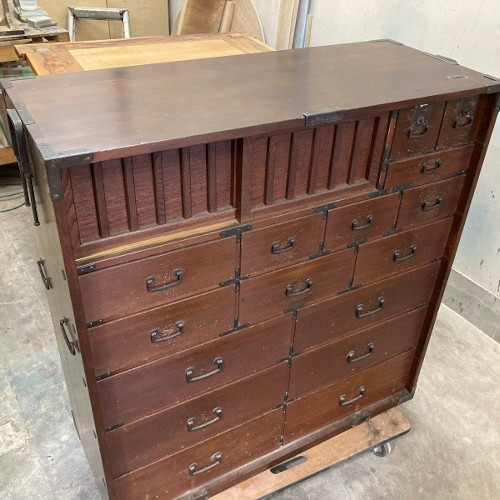
This time, we would like to introduce the repair and restoration of a very valuable choba tansu merchant chest that still retained a record of its year of manufacture and had a history of more than 100 years.
A choba tansu is a piece of furniture that was used in merchant houses to store valuables such as ledgers, cash, and seals. It is characterized by many small drawers and heavy metal fittings.
Although damage was visible after many years of use,
we carefully repaired and restored this piece so that it could continue to be used safely, while preserving as much of its original atmosphere and character as possible.
🔸Contents
1. A Valuable Choba Tansu Passed Down from the Taisho Period
2. Condition Before Repair and Damage Inspection
3. Restoration and Remodeling Work Aiming to Restore Its Original Appearance
4. A Finish That Preserves the Old Metal Fittings and Design Details
5. Detailed Specifications
1. A Valuable Choba Tansu Passed Down from the Taisho Period
A choba tansu is practical furniture once used in merchant houses, while also being traditional furniture filled with beautiful design details and craftsmanship.
The chest introduced here is an extremely valuable piece known to have been made during the Taisho period.
Various large and small drawers, heavy iron fittings, and the finely divided storage spaces unique to choba tansu remained throughout the piece, showing the appeal of hand craftsmanship that is difficult to reproduce today.
Furniture like this is not simply storage furniture. It is also an important presence that has carried family history and memories.
To avoid damaging that value, we aimed to restore it while preserving as much of its original atmosphere as possible.
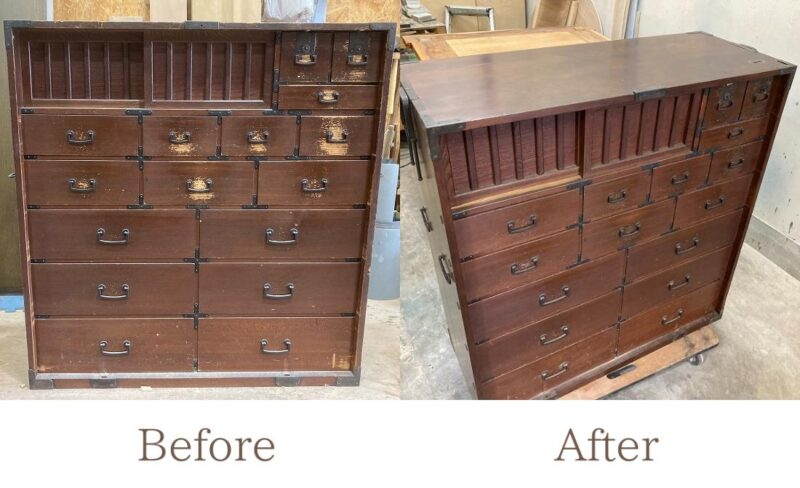
2. Condition Before Repair and Damage Inspection
Because it had been used for more than 100 years, age-related damage was visible in many areas.
| Condition Before Repair | Details |
|---|---|
| Finish | The coating had peeled, and scratches and fading were visible throughout. |
| Back Panel | There was a large crack, and a decrease in strength was visible. |
| Lock | The area around the lock was damaged, making it impossible to lock. |
| Overall | Although signs of long-term use remained, the structure itself was still solid. |
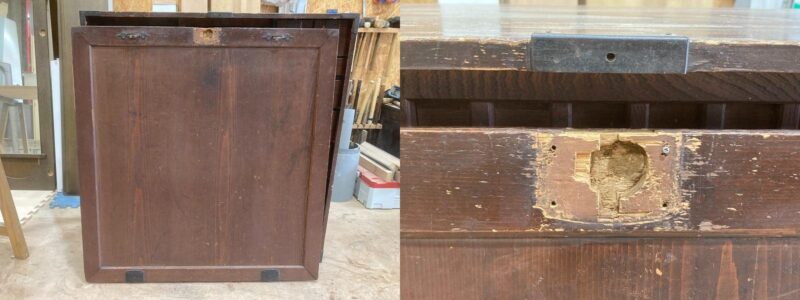
The top surface in particular showed noticeable scratches and finish wear, giving a clear sense of the history of daily use.
On the other hand, the iron fittings, small drawers, and other features unique to choba tansu were still well preserved. Making use of those elements became the main theme of this restoration.
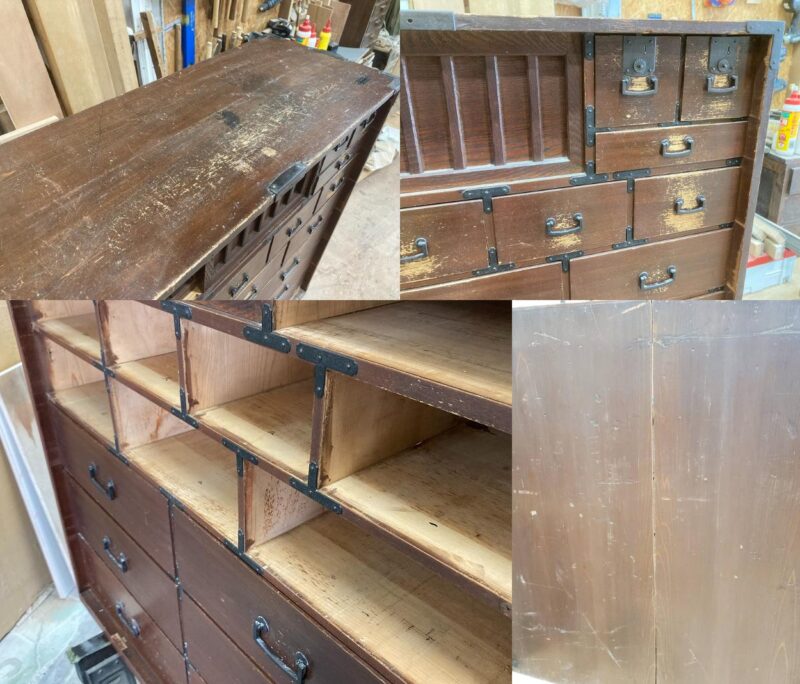
3. Restoration and Remodeling Work Aiming to Restore Its Original Appearance
For this remodeling project, rather than making the chest look “like new,”
we proceeded with the goal of “bringing it closer to the appearance it had when it was completed in the Taisho period.”
■ New Lock Production
The damaged lock could not be replaced with a ready-made product, so a new one was custom-made. While matching the shape so as not to compromise the original design, we finished it with the precision needed for safe use today.
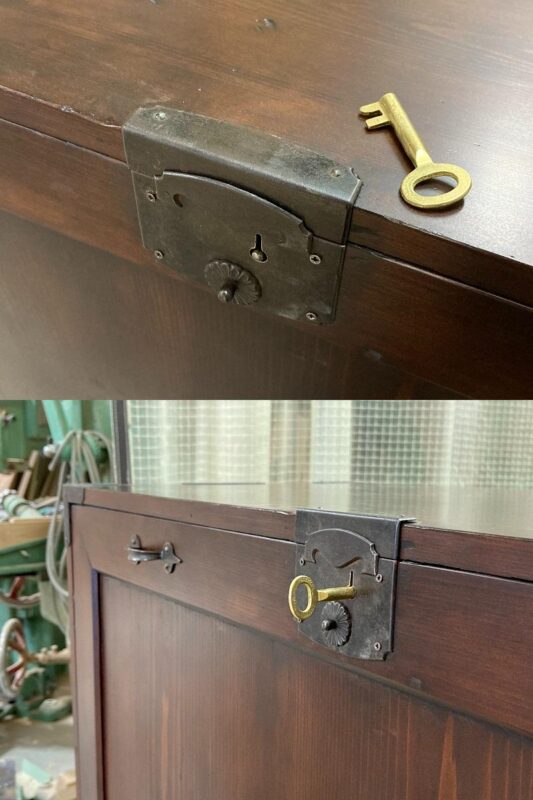
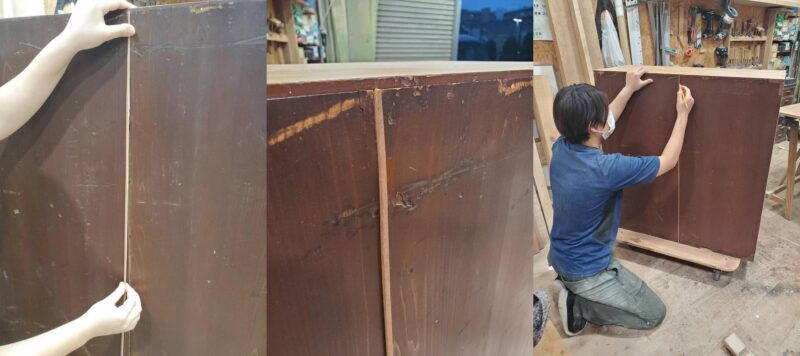
■ Repair of the Cracked Back Panel
Because a large crack had developed in the back panel, we repaired it using wood inlay.
We carefully finished the repair so that the wood grain would look natural while also reinforcing the panel, restoring both appearance and strength.
■ Full Surface Sanding and Lacquer Refinishing
The entire surface was sanded to remove years of accumulated scratches and deteriorated coating.
After that, we applied a lacquer finish while adjusting it to a calm color tone, creating an elegant texture with a restrained sheen.
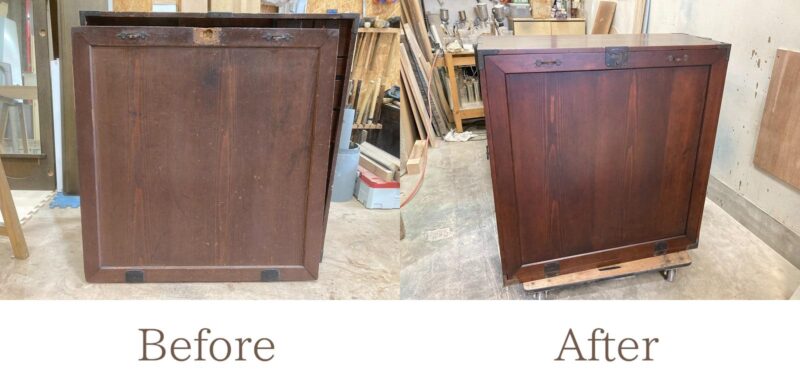
Rather than giving it a flashy, brand-new shine, we placed importance on the calm character of furniture that has aged over many years.
4. A Finish That Preserves the Old Metal Fittings and Design Details
The appeal of a choba tansu lies in its small drawers, heavy iron fittings, and unique storage configuration.
In this remodeling project, we carried out the restoration while preserving those features as much as possible.
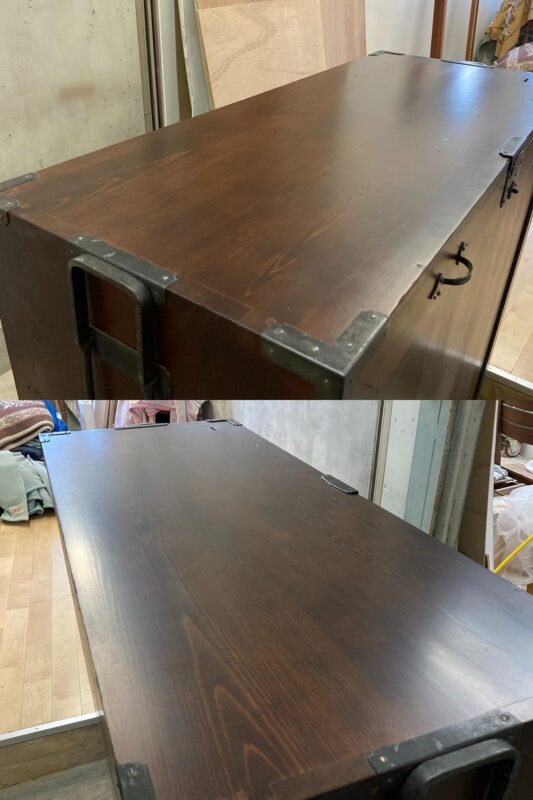
Instead of replacing everything with new parts, we made use of what could still be used.
This is very important when restoring antique furniture.
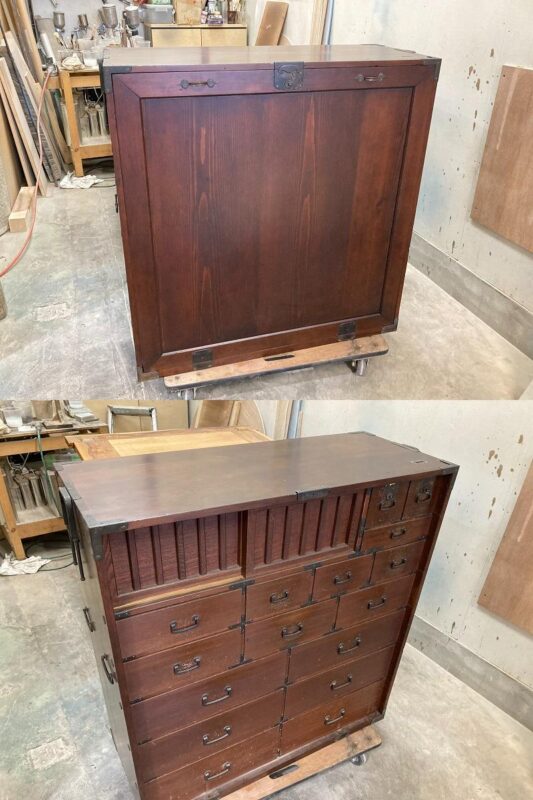
The finished chest was reborn as furniture that can be used safely in modern life while retaining the atmosphere of the Taisho period.
For us as craftspeople, it is a great joy to see furniture from more than 100 years ago become useful in everyday life once again.
5. Detailed Specifications
| Furniture | Choba tansu merchant chest |
|---|---|
| Period of Production | Taisho period, more than 100 years ago |
| Work Details | Lock production, back panel repair, full surface sanding, lacquer refinishing, and adjustment of each part |
Summary
Old furniture does not always need to be discarded simply because it has become damaged.
Especially with historically valuable furniture such as choba tansu, proper restoration can make it possible to continue using the piece for many more decades.
At OJIKI Workshop, we do more than repair scratches and damage. We carefully remodel and restore each piece so that its history and memories can also be passed on.
If you would like to continue using a piece of furniture filled with memories, or if you are considering repairing an old tansu chest, please feel free to contact OJIKI Workshop.
At OJIKI Workshop, we handle not only custom-made furniture and architectural woodwork, but also a wide range of repair and maintenance services, including restoration of high-gloss painted finishes on well-used furniture and the revival of antique furniture.
For detailed consultations and estimates, please feel free to contact us via our official LINE account, by phone, or through our inquiry form.
Phone: 046-204-5592 (Weekdays 9:00–18:00)
LINE: OJIKI Workshop Official Account


《About OJIKI Workshop》
OJIKI Workshop manufactures and sells furniture, doors, and architectural woodwork made from solid natural wood.
In addition to selling our original products, we also provide custom-made furniture, remodeling, repair, and maintenance services for unused furniture, aged doors, and built-in woodwork that no longer suits modern lifestyles.
For remodeling, repair, and maintenance projects, we listen carefully to our clients’ requests regarding design, functionality, and usability before beginning production. This approach has earned us many words of appreciation from our customers.
We hope to meet the needs of customers who wish to use their wooden furniture and wooden architectural elements with care for many years to come.
⚫︎You want to repair and maintain beloved furniture or doors so you can continue using them for a long time.
⚫︎You want to remodel furniture that your family has used for many years so it better suits your current lifestyle.
⚫︎You want to order custom-made furniture or doors made from natural materials, with careful attention to both design and usability.
⚫︎You want to live in a healthier environment, both physically and mentally, by using natural materials in the furniture and doors of your home.
⚫︎You want to incorporate a relaxing environment with natural materials into your office.
⚫︎You want to create a shop that uses plenty of natural materials.
And more.
For consultations about furniture and architectural woodwork made from natural materials, please leave it to us at OJIKI Workshop.
We look forward to hearing from you.
==============
OJIKI Co., Ltd.
Wooden Furniture and Wooden Architectural Woodwork [Custom-Made, Remodeling, Repair]
Zama, Yamato, Sagamihara
5-49-16 Hibarigaoka, Zama City, Kanagawa 252-0003, Japan
Phone: 046-204-5592 (Weekdays 9:00–18:00)
Representative Director: Kenichi Okawa
Profile
Graduated from the Department of Architecture, Faculty of Engineering, Tokai University
Graduated from Chippendale International School of Furniture in the United Kingdom
(Furniture making and antique furniture repair)
Trained for three years at Rengesou Motomachi Workshop
Based on the traditional production process of Yokohama furniture, which has continued for more than 100 years, he continues to explore new designs using materials such as iron, leather, and glass while engaging in woodworking every day.
==============