Custom-Made Lattice Bookshelves with an Integrated Counter Desk Across Three Walls Using Traditional Kamachi-gumi Frame Construction | Private Residence in Setagaya, Tokyo
Custom-Made Oak Lattice Bookshelves with an Integrated Counter Desk Across Three Walls
Custom Furniture, Built-Ins, Furniture Repurposing, Repairs & Maintenance | OJIKI Workshop
This project showcases a custom-made, large wall-to-wall bookshelf with an integrated counter desk, created for a customer in Setagaya, Tokyo.
Having enough space to store books and documents while also keeping a desk for working or reading can be challenging. Placing separate pieces of furniture in a room often takes up valuable floor space, making the room feel smaller.
However, by making better use of the available wall space, it is possible to combine generous storage with a comfortable workspace without overcrowding the room.
For this project, we developed detailed drawings based on a designer’s concept and brought the design to life. The bookshelves feature an oak lattice framework, mill-scale steel shelves, brass rods, and a counter desk with a linoleum worktop.
The result is a practical combination of storage and workspace that also brings the natural warmth of wood into the room.
In this article, we introduce the design, materials, and thoughtful details that make this custom-made furniture unique.
🔸Table of Contents
1. Large Bookshelves Making Use of Three Walls
2. Beautiful Oak Lattice Design Using Traditional Frame Joinery
3. Bookshelves Combining Mill-Scale Steel Shelves and Brass Rods
4. Counter Desk with a Linoleum Worktop and Closet Storage
5. Custom-Made Furniture That Brings a Designer’s Ideas to Life
1. Large Bookshelves Making Use of Three Walls
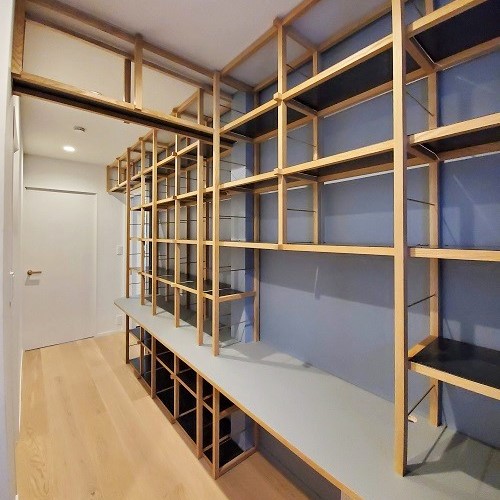
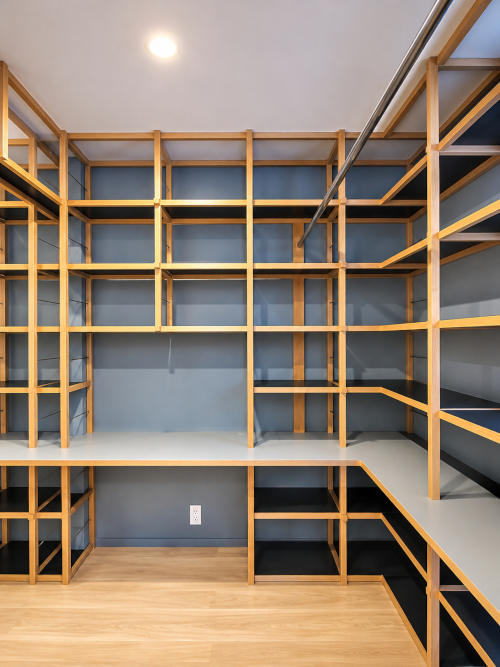
For this project, we created a large bookshelf system that makes use of three walls in the room.
While conventional bookshelves are usually installed along a single wall, this design connects lattice-style shelving units along three walls using a traditional frame construction technique known in Japan as “Kamachi-gumi.”
This arrangement makes effective use of the available space throughout the room.
The bookshelves extend almost to the ceiling, providing extensive storage across the walls.

Maximizing Storage by Using Wall Space
As books and documents accumulate, it can be tempting to add more storage furniture. However, each additional cabinet or bookshelf takes up floor space and can make a room feel increasingly crowded.
Wall-to-wall storage offers a different approach. By making use of the height and width of the walls, it is possible to increase storage capacity without filling the room with separate pieces of furniture.
Combining bookshelves and a desk also allows storage and workspace to be organized in one convenient area.
Designed Around Windows, Doorways, and the Closet Entrance
The lattice-style shelves extend continuously along the walls, with the corner areas also used for storage.
The shelving was carefully designed around the positions of the windows and doorways, allowing us to make full use of the walls while maintaining comfortable access throughout the room.
This kind of customized layout is difficult to achieve simply by combining ready-made bookshelves.
Custom-made furniture allows the dimensions and arrangement to be tailored to the room’s walls, windows, and architectural features.

2. Beautiful Oak Lattice Design Using Traditional Frame Joinery
One of the most distinctive features of these bookshelves is the lattice design, created using oak and a traditional Japanese frame construction technique called “Kamachi-gumi.”
By joining slender vertical and horizontal wooden members, we created a series of clean, regular lines across the walls.
Although the bookshelves are large, the open lattice structure allows the wall behind them to remain visible, giving the furniture a lighter, more open appearance.
The Natural Grain and Warmth of Oak
Oak is a relatively hard and durable hardwood commonly used for furniture and flooring.
Its distinctive grain makes it suitable for a wide range of interior styles, from natural and relaxed spaces to sophisticated modern designs.
For this project, light-colored oak was assembled into a slender lattice framework using Kamachi-gumi construction.
The natural wood tones contrast beautifully with the gray walls behind the shelves, highlighting the oak’s grain and warm appearance.
What Is Kamachi-gumi Frame Construction?
The woodworking technique used for this project is called “Kamachi-gumi,” a traditional Japanese method of frame construction.
What is Kamachi-gumi? A woodworking technique that creates a frame structure by joining vertical and horizontal wooden members.
Commonly used for furniture doors and architectural fittings, Kamachi-gumi allows woodworkers to create clean, structured wooden frames.
When used for lattice-style storage furniture, the framework itself becomes an attractive design feature, even when the shelves are empty.
For this bookshelf, the technique helped us achieve a beautifully balanced arrangement of vertical and horizontal lines.
Looking closely at the enlarged details in the photographs, you can see how the slender wooden components are carefully joined to create the regular lattice pattern.

3. Bookshelves Combining Mill-Scale Steel Shelves and Brass Rods
The shelves in this project are made from mill-scale steel, while brass rods are incorporated into selected sections to serve as built-in book supports.
Combining wood and metal adds visual contrast while also improving the functionality of the bookshelves.
The Understated Appearance of Mill-Scale Steel Shelves
What is mill-scale steel? Steel that retains the dark oxide layer formed on its surface during the manufacturing process.
Mill-scale steel has a distinctive dark gray to nearly black appearance and is often used in furniture and architectural design.
For this project, we paired mill-scale steel shelves with the light-colored oak framework.
The contrast between the warm wood and darker metal creates a clean, balanced appearance.
As shown in the photographs, the steel shelves blend naturally with the gray wall behind them, allowing the oak lattice structure to stand out.
Brass Rods Used as Built-In Book Supports
Brass rods were installed in selected sections of the bookshelves.
What is brass? A metal alloy made primarily from copper and zinc, known for its distinctive, subdued golden color.
The brass rods serve as additional book supports, helping prevent books from tipping sideways or falling from the shelves.
Instead of placing separate bookends on the shelves, these supporting elements are incorporated directly into the furniture.
The slender brass rods are visually unobtrusive and complement the overall lattice design.
Materials Used in the Bookshelf Design
| Material | Application | Design and Function |
|---|---|---|
| Oak | Lattice framework | Traditional frame construction featuring natural wood grain and a warm appearance |
| Mill-scale steel | Shelves | Subtle, dark tones that complement and highlight the oak lattice |
| Brass rods | Selected bookshelf sections | Integrated supports that also function as bookends |
By taking advantage of the different characteristics of each material, we created bookshelves that combine practical storage with an attractive design.

4. Counter Desk with a Linoleum Worktop and Closet Storage
In addition to the bookshelves, this wall-to-wall furniture system incorporates a counter desk and closet storage.
Books can be taken directly from the shelves and read at the desk, while the countertop also provides a convenient place for working on a computer.
By connecting the storage and workspace, the furniture supports a variety of everyday activities.
A Counter Desk Integrated into the Bookshelves
A long counter desk was incorporated into the middle section of the shelving system.
While the bookshelves have a depth of 350 mm, the countertop extends to 500 mm, providing a more comfortable working surface.
The additional depth offers space for books, notebooks, and a computer.
We also gave the corner of the countertop a gently rounded shape.
The softened corner helps reduce the chance of bumping into a sharp edge when moving around the room, while also creating a more welcoming appearance.
Linoleum Worktop
Linoleum was selected as the surface material for the counter desk.
What is linoleum? A material made primarily from natural ingredients such as linseed oil and wood flour, commonly used for furniture surfaces and flooring.
Linoleum is also used in Scandinavian furniture design. Its relatively matte surface and understated texture make it a natural match for wood.
For this project, we combined a gray linoleum worktop with the light-colored oak framework.
The warm wood tones and subdued gray surface complement each other, creating a practical and visually balanced workspace.
Closet Storage Integrated into the Layout
A closet is located at the far end of the shelving system.
As shown in the photograph, a hanging rail is installed above the closet entrance, providing space to hang clothing and other items.
The continuous furniture arrangement extends along the walls from the room entrance, combining book and document storage with a working area before reaching the closet entrance.
By integrating these functions into one large wall-to-wall bookshelf and counter desk system, we were able to make efficient use of the room without requiring several separate pieces of furniture.

5. Custom-Made Furniture That Brings a Designer’s Ideas to Life
For this project, OJIKI Workshop prepared the detailed drawings and manufactured the wall-to-wall storage system based on ideas provided by the designer.
Custom Sizes and Shapes That Ready-Made Furniture Cannot Easily Accommodate
One of the main advantages of custom-made furniture is the ability to design around the specific conditions of a room.
For large wall-to-wall storage systems like this one, several factors can be considered during the design and manufacturing process.
Advantages of Custom-Made Furniture
| Advantage | Description |
|---|---|
| Designed to fit the available wall space | Adjust the width, height, and depth to make effective use of the walls. |
| Adapted to windows and doorways | Position the shelves while considering natural light and comfortable movement throughout the room. |
| Flexible combinations of storage and workspace | Incorporate a counter desk directly into the bookshelf system. |
| Storage designed for specific items | Plan the shelving layout around books, documents, clothing, and other belongings. |
| Choice of materials and finishes | Combine different woods, metals, and countertop finishes to suit the design. |
Project-Specific Design Features
(1) Furniture: Bookshelves, counter desk with workspace, and hanging rail
(2) Dimensions: Custom-fitted to the walls, windows, doorways, and overall shape of the room
(3) Construction: Lattice-style bookshelves using Kamachi-gumi frame construction, with brass rods
(4) Materials: Oak lattice framework, mill-scale steel shelves and dividers, brass book supports, and a linoleum countertop
Suitable for Homes, Shops, and Offices
This type of wall-to-wall storage is suitable not only for home offices and hobby rooms but also for commercial spaces such as shops and offices.
For example, an office could combine document storage with a working desk, while a retail store could use a similar shelving system to display merchandise.
Project Specifications: Custom Wall-to-Wall Bookshelves
| Item | Specification |
|---|---|
| Project Location | Setagaya, Tokyo, Japan |
| Furniture Type | Large wall-to-wall bookshelves, counter desk, and closet storage |
| Main Wood Material | Oak |
| Installation Layout | U-shaped arrangement covering three walls |
| Long Side | W2500 × D350 × H2400 mm |
| Short Side | W2000 × D350 × H2400 mm |
| Countertop Depth | D500 mm |
| Shelf Material | Mill-scale steel |
| Additional Book Supports | Brass rods |
| Countertop Material | Linoleum |
*Dimensions reflect the specifications at the time of manufacture.
Frequently Asked Questions (Q&A)
Q1. Can you create custom bookshelves that cover an entire wall?
Yes. At OJIKI Workshop, we create custom bookshelves and wall-to-wall storage systems designed to fit the width and height of your walls.
We can also discuss large bookshelves that extend almost to the ceiling, as well as U-shaped storage systems that make use of multiple walls, like the one featured in this project.
Q2. Can a desk be integrated into a bookshelf?
Yes. We can incorporate a counter desk into part of a bookshelf system.
The shelf heights and countertop depth can be designed around the number of books you need to store and the equipment you plan to use, such as a computer or documents.
Q3. Can you use wood other than oak?
Yes. We can discuss different wood species based on your preferred color, grain pattern, and interior design.
Because wood species vary in their characteristics and prices, we will help you consider suitable options based on the installation location and your budget.
Q4. Will mill-scale steel shelves rust?
Mill-scale steel is still a type of steel, so rust may develop when it is exposed to moisture or humidity.
It is therefore important to consider suitable surface protection based on the installation environment and intended use.
Q5. Can architects, designers, and construction companies commission custom furniture?
Yes. OJIKI Workshop works with individual customers as well as architectural firms, construction companies, and businesses on custom furniture, doors, and built-in woodwork.
If you already have drawings, sketches, or reference images, you can send them to us when making an inquiry.
Conclusion | Combining Storage and Workspace Through Thoughtful Wall Design
In this project, we introduced a custom-made oak bookshelf and counter desk system designed to make effective use of three walls.
The U-shaped arrangement features lattice-style bookshelves extending almost to the ceiling, an integrated counter desk, and a layout carefully designed around the closet entrance.
By combining the natural grain of oak with mill-scale steel shelves, brass rods, and a linoleum countertop, we created furniture that offers both generous storage and an attractive mix of materials.
Bookshelves and desks are pieces of furniture we use regularly over many years. Choosing furniture that suits the items you need to store, your working habits, and the atmosphere of your room can make everyday life more comfortable.
This project demonstrates how custom-made furniture can bring storage and workspace together while making effective use of available wall space.
OJIKI Workshop creates custom bookshelves, counter desks, closet storage, and other furniture for homes and commercial spaces.
If you are thinking:
“I want bookshelves that cover an entire wall.”
“I would like to combine storage and a desk.”
“I cannot find ready-made furniture that fits my room.”
Please feel free to contact us to discuss your ideas.
From Inquiry to Delivery | How to Order Custom Furniture from OJIKI Workshop
If you are considering custom-made furniture, you may not have a specific design in mind yet, or you may be unsure how much a wall-to-wall storage system would cost.
At OJIKI Workshop, we work with you to explore suitable designs and materials based on your preferences and the conditions of the installation space.
Please feel free to get in touch, even if your ideas are still at an early stage.
1. Initial Inquiry
Contact us by phone, LINE, or our online inquiry form.
If you have photographs of the installation area, drawings, measurements, or reference images, please include them with your inquiry.
2. Consultation and Planning
We will discuss your preferred dimensions, design, storage requirements, wood materials, and budget.
For larger storage systems, we will also check the access route for delivery and any conditions that may affect installation.
3. Quotation
Based on the information provided, we will prepare a quotation for the furniture.
Quotations requested online using a smartphone or computer are free of charge.
4. Furniture Manufacturing
Once your order is confirmed, we begin manufacturing the furniture in our workshop.
The process includes woodworking, assembly, and finishing to create furniture tailored to your requirements.
5. Delivery and Installation
Once completed, we deliver the furniture to your location.
For large wall-to-wall storage systems, we can also discuss on-site assembly and installation arrangements.
At OJIKI Workshop, we handle not only custom-made furniture and architectural woodwork, but also a wide range of repair and maintenance services, including restoration of high-gloss painted finishes on well-used furniture and the revival of antique furniture.
For detailed consultations and estimates, please feel free to contact us via our official LINE account, by phone, or through our inquiry form.
Phone: 046-204-5592 (Weekdays 9:00–18:00)
LINE: OJIKI Workshop Official Account


《About OJIKI Workshop》
OJIKI Workshop manufactures and sells furniture, doors, and architectural woodwork made from solid natural wood.
In addition to selling our original products, we also provide custom-made furniture, remodeling, repair, and maintenance services for unused furniture, aged doors, and built-in woodwork that no longer suits modern lifestyles.
For remodeling, repair, and maintenance projects, we listen carefully to our clients’ requests regarding design, functionality, and usability before beginning production. This approach has earned us many words of appreciation from our customers.
We hope to meet the needs of customers who wish to use their wooden furniture and wooden architectural elements with care for many years to come.
⚫︎You want to repair and maintain beloved furniture or doors so you can continue using them for a long time.
⚫︎You want to remodel furniture that your family has used for many years so it better suits your current lifestyle.
⚫︎You want to order custom-made furniture or doors made from natural materials, with careful attention to both design and usability.
⚫︎You want to live in a healthier environment, both physically and mentally, by using natural materials in the furniture and doors of your home.
⚫︎You want to incorporate a relaxing environment with natural materials into your office.
⚫︎You want to create a shop that uses plenty of natural materials.
And more.
For consultations about furniture and architectural woodwork made from natural materials, please leave it to us at OJIKI Workshop.
We look forward to hearing from you.
==============
OJIKI Co., Ltd.
Wooden Furniture and Wooden Architectural Woodwork [Custom-Made, Remodeling, Repair]
Zama, Yamato, Sagamihara
5-49-16 Hibarigaoka, Zama City, Kanagawa 252-0003, Japan
Phone: 046-204-5592 (Weekdays 9:00–18:00)
Representative Director: Kenichi Okawa
Profile
Graduated from the Department of Architecture, Faculty of Engineering, Tokai University
Graduated from Chippendale International School of Furniture in the United Kingdom
(Furniture making and antique furniture repair)
Trained for three years at Rengesou Motomachi Workshop
Based on the traditional production process of Yokohama furniture, which has continued for more than 100 years, he continues to explore new designs using materials such as iron, leather, and glass while engaging in woodworking every day.
==============