《Repair / Restoration》Restoring a Cherished Teak Round Table | Repairing Warping and Cracks and Refinishing the Surface
Restoring a Teak Round Table: Repairs and Refinishing
Custom Furniture, Doors, Built-ins, Repurposing, Repair & Maintenance | OJIKI Workshop
This project features the repair, maintenance, and refinishing of a teak round table that the customer had used for many years. Although the tabletop had developed significant wear and damage, the customer wanted to continue using this cherished piece, so we restored and refinished the entire table, including the tabletop.
A dining table used every day for meals and time with family naturally accumulates scratches and stains over the years. With furniture made from natural wood, the timber also expands and contracts over time, which can eventually cause warping and cracking.
This teak round table had not only developed surface damage but also significant warping and cracks caused by the wood shrinking over time. For this reason, simply refinishing the surface would not have been enough. We disassembled the tabletop, re-milled the individual boards, and carefully joined them together again as part of a more extensive restoration.
Our goal was to preserve as much of the table’s original character as possible while restoring it so that it could continue to be enjoyed for many more years. Here is a closer look at the restoration process.
🔸Contents
1. A Teak Round Table Used and Cherished for Many Years
2. Disassembling the Tabletop to Repair Warping and Cracks
3. Re-Milling and Rejoining the Timber
4. Refinishing While Preserving the Table’s Original Character
5. Repairing Cherished Furniture for Years of Continued Use
1. A Teak Round Table Used and Cherished for Many Years
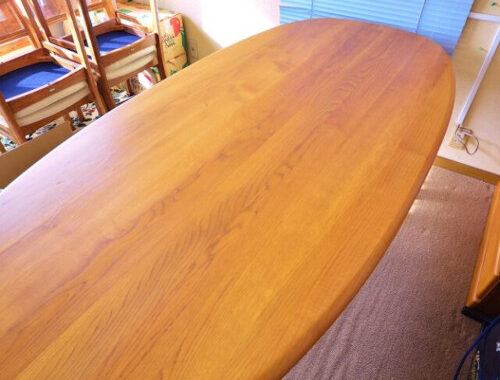
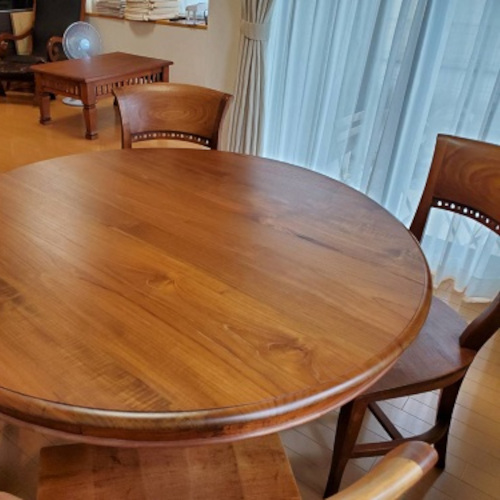
The piece brought to us was a large round table made from teak.
Although the table had developed considerable wear, the customer wanted to continue using it for years to come. We therefore carried out repairs and refinishing on the entire table, including the tabletop.
As the before photo shows, years of use had caused deterioration and uneven coloration in the tabletop finish.
Another major issue was warping and cracking caused by the natural shrinkage and movement of the wood.
Natural wood repeatedly expands and contracts in response to changes in humidity and other environmental conditions. Over many years, this movement can result in warping, cracks, and separation or misalignment along the joints of a tabletop.
In this case, the wood had undergone considerable shrinkage over time, resulting in significant warping and cracking. We therefore decided that the table needed to be repaired from the wood itself rather than simply refinished at the surface.

2. Disassembling the Tabletop to Repair Warping and Cracks
One of the most important steps in this restoration was completely disassembling the tabletop.
The round tabletop was originally constructed by joining several pieces of timber together. We first separated the glued joints so that the tabletop could be taken apart into its individual boards.
At first glance, it may seem surprising that such extensive disassembly is necessary.
However, when a tabletop is severely warped, simply planing down the surface can remove too much material and make the tabletop unnecessarily thin.
For this reason, we chose to separate the boards first and correct each piece individually while carefully assessing its condition.
As shown in the photos, our craftsman used a hand plane to work on the tabletop before further processing the timber with professional woodworking machinery.

3. Re-Milling and Rejoining the Timber
Once the tabletop had been disassembled, each board was carefully re-milled to remove as much of the warping as possible. After the individual pieces had been properly adjusted, they were joined together again to recreate a single tabletop.
One of the challenges of furniture restoration is that the conditions are very different from making a new piece of furniture from scratch.
Because we are working with an existing piece, there are various limitations to consider, including:
・The original thickness of the tabletop
・The overall dimensions of the table
・The amount of original wood that can be preserved
・How the repaired components fit with the existing structure
Simply removing more material does not necessarily make the repair easier. It is important to carefully determine exactly where and how much material needs to be removed while preserving as much of the original furniture as possible.
After the necessary adjustments were completed, the boards were joined together again and carefully shaped to restore the tabletop to its original round form.

4. Refinishing While Preserving the Table’s Original Character
Once the structural repairs were complete, the final stage was refinishing.
We carefully adjusted the color to preserve as much of the table’s original appearance and character as possible.
Because this was a piece the customer had used for many years, we wanted the restored table to retain the familiar character and atmosphere it had developed over time. The finish was therefore carefully color-matched so that the repaired areas would blend naturally with the existing parts of the table.
Once completed, the table once again revealed the warm tones and understated grain characteristic of teak. By restoring not only the tabletop surface but also the substantial rounded edge that gives the table its distinctive appearance, we were able to bring a sense of visual unity back to the entire piece.
Compared with its condition before restoration, the surface damage and uneven coloration are now far less noticeable, allowing the natural beauty of the teak grain to stand out once again.

5. Repairing Cherished Furniture for Years of Continued Use
When a piece of furniture that has been used for many years begins to show scratches, cracks, or warping, it is natural to wonder whether it might be time to replace it.
Depending on the condition of the furniture, replacement may sometimes be the best option. However, some pieces can be restored to a condition in which they can continue to be used for many more years by disassembling and rebuilding the wooden components, as we did in this project, or by removing and renewing a deteriorated finish.
This is particularly true of tables made from natural wood and furniture with sentimental value, as finding an identical replacement may be difficult or even impossible.
Choosing to repair furniture is about more than simply making an old piece look better. It is also a way to preserve the qualities and character of a piece that has already been part of your life and carry them forward into the years ahead.

Conclusion
This project involved the repair and restoration of a teak round table that had been used and cherished for many years.
Because we had to work within the limitations of the table’s existing thickness and dimensions, the restoration required considerable care and craftsmanship.
After completion, however, the beautiful grain and warm character of the teak had been restored, giving the table a remarkable new appearance. We were also delighted that the customer was very pleased with the finished result.
At OJIKI Workshop, we provide furniture repair and maintenance tailored to the condition of each individual piece, including repairs to scratches, cracks, and warping in dining tables, as well as tabletop refinishing.
If you would like to continue using a table you have cherished for many years, or if you are unsure whether your damaged furniture can be repaired, please feel free to contact us. We will carefully assess its condition and recommend an appropriate repair or restoration method.
At OJIKI Workshop, we handle not only custom-made furniture and architectural woodwork, but also a wide range of repair and maintenance services, including restoration of high-gloss painted finishes on well-used furniture and the revival of antique furniture.
For detailed consultations and estimates, please feel free to contact us via our official LINE account, by phone, or through our inquiry form.
Phone: 046-204-5592 (Weekdays 9:00–18:00)
LINE: OJIKI Workshop Official Account


《About OJIKI Workshop》
OJIKI Workshop manufactures and sells furniture, doors, and architectural woodwork made from solid natural wood.
In addition to selling our original products, we also provide custom-made furniture, remodeling, repair, and maintenance services for unused furniture, aged doors, and built-in woodwork that no longer suits modern lifestyles.
For remodeling, repair, and maintenance projects, we listen carefully to our clients’ requests regarding design, functionality, and usability before beginning production. This approach has earned us many words of appreciation from our customers.
We hope to meet the needs of customers who wish to use their wooden furniture and wooden architectural elements with care for many years to come.
⚫︎You want to repair and maintain beloved furniture or doors so you can continue using them for a long time.
⚫︎You want to remodel furniture that your family has used for many years so it better suits your current lifestyle.
⚫︎You want to order custom-made furniture or doors made from natural materials, with careful attention to both design and usability.
⚫︎You want to live in a healthier environment, both physically and mentally, by using natural materials in the furniture and doors of your home.
⚫︎You want to incorporate a relaxing environment with natural materials into your office.
⚫︎You want to create a shop that uses plenty of natural materials.
And more.
For consultations about furniture and architectural woodwork made from natural materials, please leave it to us at OJIKI Workshop.
We look forward to hearing from you.
==============
OJIKI Co., Ltd.
Wooden Furniture and Wooden Architectural Woodwork [Custom-Made, Remodeling, Repair]
Zama, Yamato, Sagamihara
5-49-16 Hibarigaoka, Zama City, Kanagawa 252-0003, Japan
Phone: 046-204-5592 (Weekdays 9:00–18:00)
Representative Director: Kenichi Okawa
Profile
Graduated from the Department of Architecture, Faculty of Engineering, Tokai University
Graduated from Chippendale International School of Furniture in the United Kingdom
(Furniture making and antique furniture repair)
Trained for three years at Rengesou Motomachi Workshop
Based on the traditional production process of Yokohama furniture, which has continued for more than 100 years, he continues to explore new designs using materials such as iron, leather, and glass while engaging in woodworking every day.
==============