


Are Your Table and Chair Heights Right? Tips for Choosing Comfortable Heights Without Regret
Have you ever felt any of the following while eating at your dining table, working on a computer, or writing?
“My shoulders feel stiff for some reason.”
“I end up leaning forward.”
“I like the chair, but the table feels slightly difficult to use.”
And more.
One possible cause is the balance between the height of the table and the chair.
When choosing furniture, it is easy to focus on design and materials, but when thinking about everyday usability, “height” is also a very important point. Dining tables and desks in particular are used not only for meals, but also for reading, work, children’s homework, and many other daily activities where people spend a long time.
In this article, we will introduce the relationship between table and chair height, general height guidelines that are considered comfortable, the difference between ready-made and custom-made furniture, and height adjustments available at OJIKI Workshop. Please read to the end.
Contents
- What is the height difference between a table and chair?
- What can happen when the heights do not match?
- General guidelines for table and chair height
- The difference between ready-made and custom-made furniture
- Height adjustments available at OJIKI Workshop
1. What is the height difference between a table and chair?
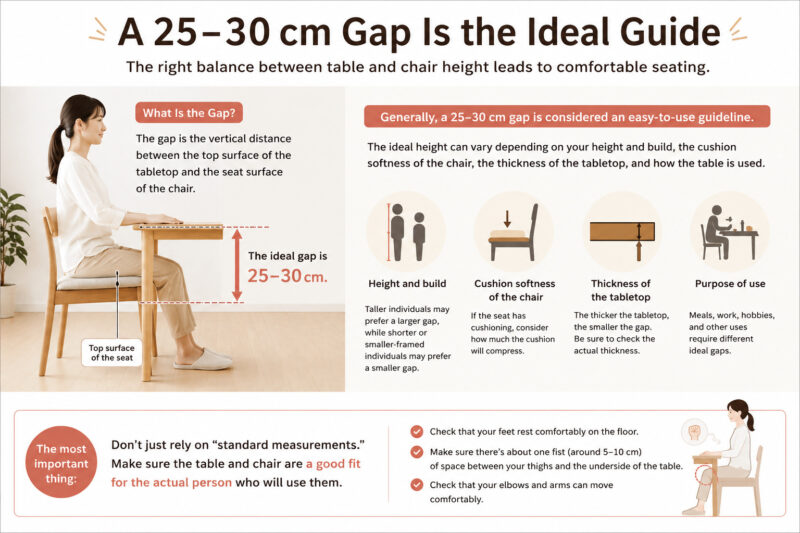
The difference between the top surface of the tabletop and the seat surface of the chair is called the table-chair height difference.
In general, a comfortable height difference between a dining table and chair is considered to be around 25 cm to 30 cm.
For example, if the chair seat height is 42 cm, a table height of around 67 cm to 72 cm can be used as one guideline.
When the height falls within this range, it becomes easier to place your arms naturally while eating or working, reducing strain on the body.
Of course, this is only a general guideline.
The ideal height will vary depending on height, body type, how much the chair cushion sinks, the thickness of the tabletop, and the intended use.
What matters is not simply thinking, “It is an average size, so it should be fine,” but checking whether it actually suits the person using it and the chair being used.

2. What can happen when the heights do not match?
If the table and chair heights do not match, even if it is not obvious at first glance, it can affect everyday comfort and place strain on the body.
For example, spending long periods with a table-chair height difference that does not suit your body may lead not only to stiff shoulders, but also neck stiffness, lower back strain, tightness in the back, and fatigue in the arms or wrists. This is because you may unknowingly put strain on your body by taking an unnatural posture each time you eat or work.
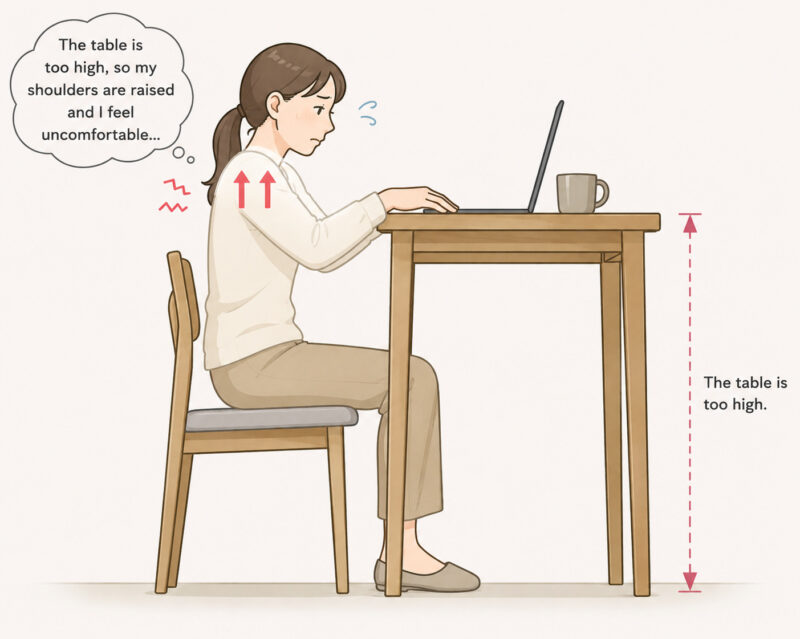
◯When the table is too high
Your shoulders tend to rise while eating or working.
Because your posture feels as if you are lifting your arms, using the table for a long time can easily place strain around the shoulders and neck.
In addition, the position of your elbows and wrists may become unnatural, making your arms more likely to tire when writing or using a computer. Even while eating, you may feel less relaxed because your arms remain lifted.
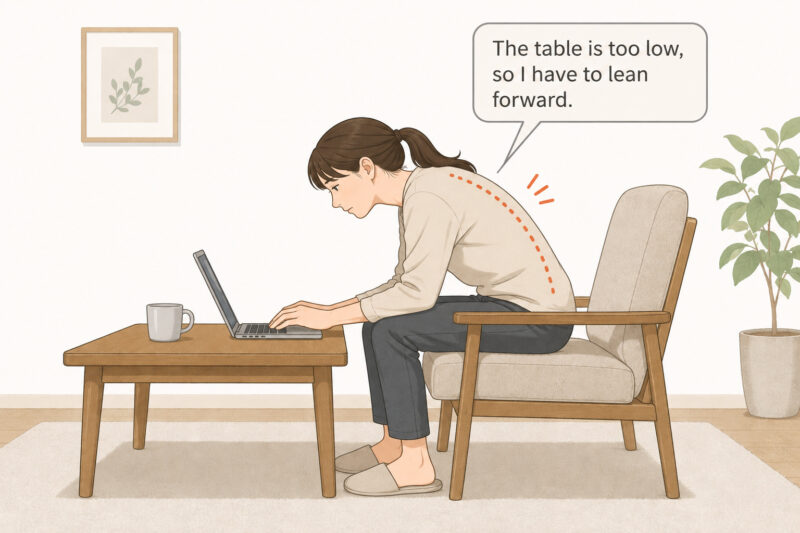
◯When the table is too low
Your back tends to round, making it easier to lean forward.
Your face may come closer to the table while eating, or your posture may collapse while writing or working on a computer.
If a forward-leaning posture continues, strain can easily build up in the neck, back, and lower back. Especially when a dining table is also used for work or study, your posture may collapse while concentrating, leading to fatigue.
A dining table in particular is a place used by the whole family.
Even if it feels just right for adults, it may be too high for children or slightly difficult to use for smaller people.
The sense that the height does not quite feel right may be small at first.
However, because it is furniture used every day, even a small difference can greatly affect posture, physical strain, and ease of living. When choosing a table and chair, it is important to check not only the appearance and size, but also whether you can use them in a comfortable posture when actually sitting down.

3. General guidelines for table and chair height
Many ready-made dining tables have a tabletop height of around 70 cm. A common chair seat height is around 40 cm to 45 cm.
With this combination, the height difference between the table and chair is likely to be around 25 cm to 30 cm, making it close to a comfortable size for many people.
| Item | General guideline | Point to check |
|---|---|---|
| Table height | Around 70 cm | Whether your shoulders rise while eating or working |
| Chair seat height | Around 40 cm to 45 cm | Whether the soles of your feet can rest easily on the floor |
| Height difference | Around 25 cm to 30 cm | Whether you can rest your elbows naturally |
When considering table height based on chair seat height, the following can be used as a guideline.
| Chair seat height | Comfortable table height guideline |
|---|---|
| 40 cm | Around 65 cm to 70 cm |
| 42 cm | Around 67 cm to 72 cm |
| 45 cm | Around 70 cm to 75 cm |
However, if the chair has cushioning, the seat will sink slightly when you sit down. Considering not only the catalog seat height but also the actual height when seated will make it easier to find a more comfortable balance.
Self-Check: Three points you can check now to see whether your table and chair heights match
If you are wondering, “Are the heights of my furniture at home properly balanced?” first sit in your chair as usual and place both hands on the table.
Whether the height is ergonomically suitable for you can be easily checked through three signs your body gives you.
(1) Your feet naturally reach the floor or footrest
When seated, adjust the height so your feet can naturally and comfortably reach the floor or footrest.
NG: If your heels are floating or only your toes touch the floor, the chair seat is too high.
The backs of your thighs may be compressed, worsening blood flow and causing swollen or cold feet.
Conversely, if your knees are raised too high, meaning your knees are higher than your hips, the chair is too low and may place strain on your lower back.
(2) Elbow angle: 90 to 100 degrees when placing your hands on the table
Next, move your body closer to the table.
When you lightly keep your arms close to your sides and place your hands on the table, your elbows should be at an angle close to a right angle, around 90 to 100 degrees.
This allows your shoulders to relax naturally and your arms to rest comfortably.
NG: If your elbow angle is less than 90 degrees and you feel as if your arms are being lifted, this is a sign that the table is too high, or the chair is too low.
Because this keeps your shoulders constantly raised, it can easily lead to severe shoulder stiffness and headaches.
(3) Keep your back straight and naturally face forward
When you gently straighten your back, it is ideal if your line of sight does not drop too far and you are naturally looking diagonally forward.
NG sign: If the table is too low, you will inevitably lean forward and look down at your hands, creating a hunched posture.
Because the weight of the head, about 5 kg, places strain on the neck and back, this can become a major cause of straight neck posture and lower back pain.
Advice from OJIKI Workshop Because these are places where you spend time every day, it is important to create an environment that does not place stress on your body. If you feel, “Maybe our table is a little too high,” adjusting the chair seat height or table legs can make a dramatic difference in comfort. Please feel free to consult us about your current table and chair sizes.
4. The difference between ready-made and custom-made furniture
Ready-made tables and chairs are made to general dimensions, so they are easy to choose and can be used right away.
They also come in a wide range of designs and price ranges, making them easy to incorporate into daily life.
On the other hand, if you want to match a new table to chairs you already use, or if you want to suit the body types of your family members, ready-made dimensions may not be quite right.
For example, do you have any of the following concerns?
“The table feels a little too high for my favorite chair.”
“Chairs with arms do not fit under the table.”
“A standard table feels too high for a smaller family member.”
“I want a height that is easy to use not only for meals, but also for work and study.”
“Ready-made sizes do not quite match the room or how we want to use it.”
In these situations, custom-made furniture can be very useful.
With custom-made furniture, not only the width and depth, but also the height can be adjusted to suit your lifestyle. Even a difference of just a few centimeters can greatly change the impression and ease of use when seated.
| Type | Advantages | Points to note |
|---|---|---|
| Ready-made furniture | Easy to purchase quickly, and easy to compare prices and designs | Difficult to finely adjust the height or leg area |
| Custom-made furniture | Dimensions can be adjusted to suit the user, chair, room, and purpose | Production time is required |
Because this is furniture used every day, it is important to choose it with not only design but also usability in mind.
5. Height adjustments available at OJIKI Workshop
At OJIKI Workshop, when producing dining tables, desks, and other furniture, we can adjust the height to suit the lifestyle of the person using it.
For example, we can decide the table height based on the chairs you already own, or consider dimensions that are easy to use depending on whether the table will be used for meals, work, or other purposes.
During production, we can discuss the following points with you.
・Seat height of the chair you use
・Height and body type of the person using it
・Whether it will be used mainly for meals, or also for work and study
・Whether chairs with arms will be used
・Whether you want the chairs to fit neatly under the table
・Thickness of the tabletop and shape of the legs
・Whether an apron is included and how much space is available around the legs
Especially when using chairs with arms, not only the tabletop height but also the space under the table is important. Even if the table height is correct, the chair may not slide in fully depending on the position of the apron or legs.
At OJIKI Workshop, we can produce furniture with consideration not only for beautiful appearance, but also for how well the chairs fit, the amount of legroom, and everyday ease of use.
“I want a table that fits the chairs I currently use.”
“I want a height that is comfortable for the whole family.”
“Ready-made furniture does not quite match the height I need.”
“I want a table that is easy to use for both meals and work.”
If you have these kinds of concerns, we recommend reconsidering the height through custom-made furniture.
Summary
The height difference between a table and chair is generally considered comfortable at around 25 cm to 30 cm. When this difference is appropriate, your posture becomes more natural while eating or working, and everyday comfort improves.
However, the ideal height differs from person to person. Height, body type, chair shape, how much the cushion sinks, and how the furniture is used can all slightly change the best dimensions.
Ready-made furniture is easy to choose, but detailed height adjustment may be difficult.
With custom-made furniture, the table height and leg area can be adjusted to match the chairs you already own and the way you live.
At OJIKI Workshop, we can create custom-made furniture that considers not only furniture size, but also everyday ease of use.
If you feel uncomfortable with the height of your table or chair, or if you are looking for a table that fits the chairs you currently use, please feel free to contact us.
At OJIKI Workshop, we handle not only custom-made furniture and architectural woodwork, but also a wide range of repair and maintenance services, including restoration of high-gloss painted finishes on well-used furniture and the revival of antique furniture.
For detailed consultations and estimates, please feel free to contact us via our official LINE account, by phone, or through our inquiry form.
Phone: 046-204-5592 (Weekdays 9:00–18:00)
LINE: OJIKI Workshop Official Account


《About OJIKI Workshop》
OJIKI Workshop manufactures and sells furniture, doors, and architectural woodwork made from solid natural wood.
In addition to selling our original products, we also provide custom-made furniture, remodeling, repair, and maintenance services for unused furniture, aged doors, and built-in woodwork that no longer suits modern lifestyles.
For remodeling, repair, and maintenance projects, we listen carefully to our clients’ requests regarding design, functionality, and usability before beginning production. This approach has earned us many words of appreciation from our customers.
We hope to meet the needs of customers who wish to use their wooden furniture and wooden architectural elements with care for many years to come.
⚫︎You want to repair and maintain beloved furniture or doors so you can continue using them for a long time.
⚫︎You want to remodel furniture that your family has used for many years so it better suits your current lifestyle.
⚫︎You want to order custom-made furniture or doors made from natural materials, with careful attention to both design and usability.
⚫︎You want to live in a healthier environment, both physically and mentally, by using natural materials in the furniture and doors of your home.
⚫︎You want to incorporate a relaxing environment with natural materials into your office.
⚫︎You want to create a shop that uses plenty of natural materials.
And more.
For consultations about furniture and architectural woodwork made from natural materials, please leave it to us at OJIKI Workshop.
We look forward to hearing from you.
==============
OJIKI Co., Ltd.
Wooden Furniture and Wooden Architectural Woodwork [Custom-Made, Remodeling, Repair]
Zama, Yamato, Sagamihara
5-49-16 Hibarigaoka, Zama City, Kanagawa 252-0003, Japan
Phone: 046-204-5592 (Weekdays 9:00–18:00)
Representative Director: Kenichi Okawa
Profile
Graduated from the Department of Architecture, Faculty of Engineering, Tokai University
Graduated from Chippendale International School of Furniture in the United Kingdom
(Furniture making and antique furniture repair)
Trained for three years at Rengesou Motomachi Workshop
Based on the traditional production process of Yokohama furniture, which has continued for more than 100 years, he continues to explore new designs using materials such as iron, leather, and glass while engaging in woodworking every day.
==============